

Closed23 Nov 2026
Federal Public Service Commission
FPSC Consolidated Advertisement No. 4/2026 - 278 Posts in Federal Departments
📍 IslamabadBPS-16 to 20bachelor+
✓ Verified · Added 10 Nov · Source: Federal Public Service Commission · 6 Nov 2026
Asami never charges any fee and never collects applications. Apply only on official websites.
No open jobs right now · updated 26 Nov 2026
All current FPSC jobs in one place. Each FPSC jobs advertisement is explained case by case, with the official fpsc.gov.pk online apply link and the original ad for verification. The Federal Public Service Commission recruits for federal ministries and departments through consolidated advertisements roughly every month. Every FPSC advertisement we process is listed here, with the full posts table and the official apply route.
No open jobs here right now. Closed listings are kept below for reference.
Kept for reference only. You can no longer apply to these.
Federal Public Service Commission
✓ Verified · Added 10 Nov · Source: Federal Public Service Commission · 6 Nov 2026
The Federal Public Service Commission recruits officers and staff for the federal government of Pakistan. Its consolidated advertisements cover ministries, revenue, audit, customs, railways and dozens of other departments in one announcement, which is why a single FPSC advertisement can carry hundreds of posts. This hub collects every FPSC advertisement we process, plus plain guidance on the test schedule, roll number slips, results and past papers that follow each advertisement.
A consolidated advertisement groups posts from many federal departments under one number, for example Advertisement No. 4/2026. Each post inside it has its own case number, its own quota and its own eligibility conditions, so always read the row for the exact post you want rather than the advertisement as a whole.
Applications are submitted online on the FPSC portal and the printed application is not required at the first stage for most posts. The challan fee is deposited in any branch of the National Bank, State Bank or a government treasury before the closing date, and the treasury receipt number is entered in the online form.
Independent guide, not affiliated with the Federal Public Service Commission. Official notices on www.fpsc.gov.pk always take priority.
The Federal Public Service Commission is the constitutional body that recruits for the federal government's officer and senior posts, usually BS-16 and above. That covers the federal ministries and their attached departments, the Auditor-General's offices, Pakistan Railways, federal hospitals and medical colleges such as PIMS and the Federal Medical College, the Islamabad Capital Territory administration, the Ordnance and other defence-civilian services, and many more. It also runs the CSS competitive examination, the route into Pakistan's elite occupational groups such as the Police Service, Pakistan Administrative Service and Foreign Service.
For general recruitment, FPSC publishes consolidated advertisements several times a year. Each one bundles dozens of separate cases (one case per post or post group), each with its own eligibility, quota, test and timeline. That's why a single FPSC advertisement can offer hundreds of posts across very different professions.
FPSC posts are open to Pakistani citizens from every province and region, but seats are distributed by the federal provincial quota: merit, Punjab, rural and urban Sindh, Khyber Pakhtunkhwa, Balochistan, the merged districts, Gilgit-Baltistan and AJK. Each case lists how its seats are split, so your domicile decides which seats you can compete for. A case with no seat for your region isn't worth your fee.
Age limits typically sit around 21 to 30 for officer entry, with five years of general relaxation built into many cases and further relaxation for specified categories such as government servants. Qualifications are set case by case. Many BS-17 posts need a relevant master's or a 16-year degree, while professional posts need registration with PEC, PMDC or PNC.
Every general recruitment case follows broadly the same path:
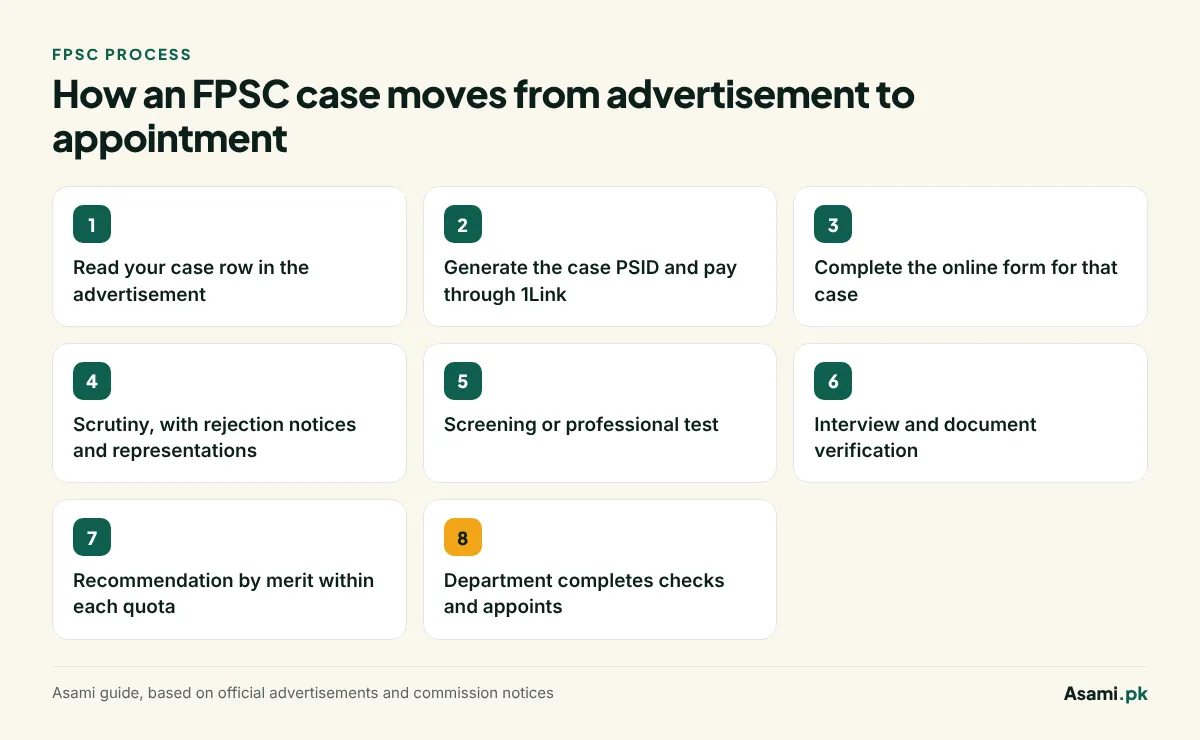
Alongside the advertisements listed above, Asami has detailed guides for each stage of the FPSC process: the test schedule, downloading the admission certificate (roll number slip), checking results, and preparing from the syllabus and past papers. Use the guide links near the top of this page. When FPSC publishes a schedule, admission certificates or a result for an advertisement on our board, we add a notice to the relevant guide and to the job's timeline.
With dozens of cases in each advertisement, it's tempting to apply widely, but every case costs a fee and preparation time. Shortlist cases where your degree exactly matches the requirement, your domicile has seats, and your age fits on the closing date. Then rank them by how well your strengths match the professional section of the test. Two well-prepared cases usually beat six rushed ones.
FPSC never asks candidates for money beyond the official case fee, which is paid only through PSID. It doesn't use agents, and no one can influence its selections. Treat any offer of a 'confirmed seat' or a leaked paper as fraud and report it.
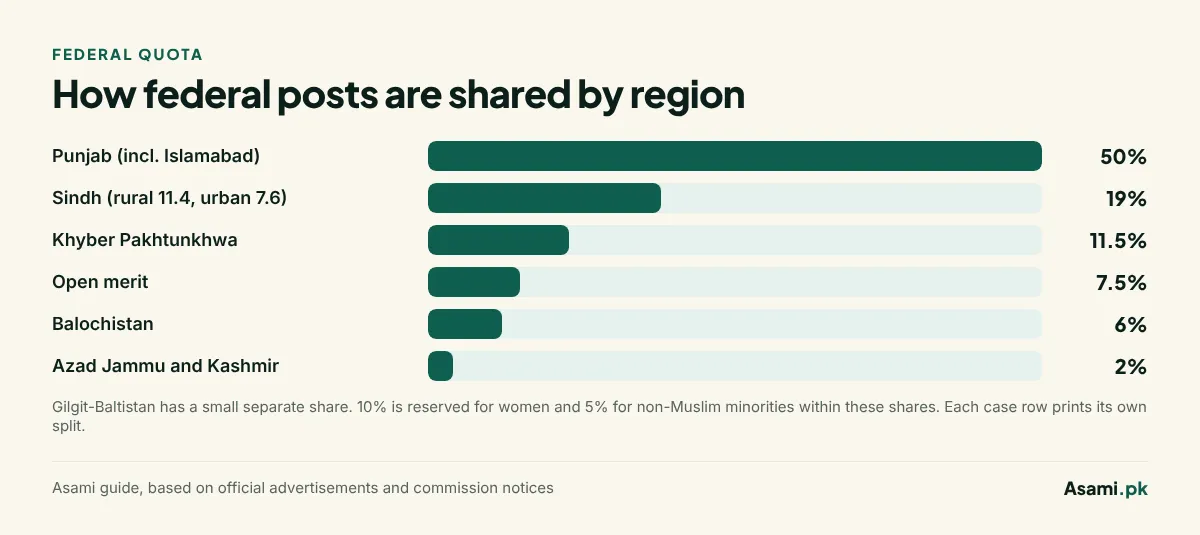
Most first-time applicants underestimate how much the quota matters. Federal posts are not filled from one national merit list. Under the federal government's regional quota policy, 7.5% of seats go on open merit and the rest are divided by region: 50% to Punjab (which includes Islamabad), 19% to Sindh (split 40:60 between urban Sindh at 7.6% and rural Sindh at 11.4%), 11.5% to Khyber Pakhtunkhwa, 6% to Balochistan and 2% to Azad Jammu and Kashmir, with a small share for Gilgit-Baltistan; the separate share for the former tribal areas has changed since their merger into Khyber Pakhtunkhwa. Within these shares, FPSC reserves 10% for women and 5% for non-Muslim minorities, and there is a quota for persons with disabilities.
In a large case with 40 seats, that split gives most regions at least one seat. In a small case with two or three seats, it often means the case is open only to one or two regions. Each case row in the advertisement prints the exact distribution, for example 'Merit 1, Punjab 2, Sindh (R) 1', and you can compete only for the seats of your own domicile plus open merit. Always read that line before paying. If your region has no seat and you are unlikely to top the national merit, the fee is better spent elsewhere.
Your domicile is the document that proves your region, and FPSC checks it at the interview. Make sure the district on your domicile matches the province you select on the form, and if you moved between provinces, check which domicile you actually hold. A mismatch discovered at interview usually means disqualification, even after you have passed the test.
A case row packs a lot into a few lines, and each part answers a different question. The case number (for example F.4-xx/2026) identifies the post for every payment, form and later notice; write it down. The post title and ministry tell you where you would work. The number of posts and the quota split tell you which seats you can compete for. The BS grade sets both the pay and the fee. The minimum qualification and experience lines decide eligibility, and the age limit, with the closing date as the reference point, decides whether you are in range.
Pay attention to small words. 'Relevant' experience means experience in the field named, not any job. 'Second division' or a percentage cut-off means FPSC checks your marks, not just the degree title. 'Or equivalent' means FPSC decides the equivalence, usually with HEC's view, so an unusual degree title is a risk. Where the row names a specific registration such as PEC, PMDC or PNC, that registration must be valid on the closing date. When a case also says 'Duty station: anywhere in Pakistan', expect to be posted outside your home city.
FPSC moved to PSID payments through 1Link so that each fee is tied to one case and one candidate. You generate the PSID from the FPSC online application system, choosing the advertisement and case, and then pay that PSID through internet banking, a mobile banking app, an ATM or a bank branch that offers 1Bill payments. The fee depends on the grade: for Advertisement 4/2026 it was Rs 600 for BS-16 and BS-17, Rs 1,500 for BS-18, Rs 2,500 for BS-19 and Rs 3,000 for BS-20 and above.
Three rules prevent most payment problems. First, one PSID pays for one case: if you want three cases, you generate and pay three PSIDs. Second, payment is not an application. You must return to the system and complete the form for that case using the paid PSID, otherwise FPSC has your money but no application. Third, keep the payment confirmation. If the form later shows the fee as unpaid, the transaction ID on your bank app is what helpdesk staff will ask for. The fee is not refunded if you are found ineligible, which is another reason to check the case row first.
The form asks for your personal details, domicile, education, experience and, for government servants, departmental details. Enter your name and date of birth exactly as on your CNIC, because these are matched against your documents at interview. For education, list every qualification from matric upward with the board or university, year and marks; the system uses the marks for some cases' eligibility. For experience, give exact start and end dates, because FPSC counts experience from the date of the minimum qualification and to the closing date.
Government servants should enter their department's details and obtain permission from their department, as required by the rules; the DPC or NOC requirements are printed in the advertisement's general instructions. Use an email address and phone number you check every day, because FPSC sends rejection notices, test schedules and interview calls electronically and sets short deadlines for responses. Before submitting, open the preview, read every field once more, and save a PDF of the final application with its tracking number.
After the closing date, FPSC scrutinises applications against the case conditions. Candidates found ineligible or with incomplete information are listed with the reason, such as 'over age', 'qualification not as required' or 'experience not as required', and they are given a short window to submit a representation with supporting documents. If your name appears on such a list, read the reason carefully. If FPSC is wrong, for example because it overlooked an age relaxation you are entitled to or misread your degree, submit the representation within the deadline with clear evidence. If the reason is correct, accept it and focus on other cases.
Many candidates miss the representation window because they only check results at the end. Keep an eye on FPSC's website and your email in the weeks after the closing date, especially for cases you care most about.
When a case attracts many applicants, FPSC holds a screening test to shortlist them for interview. In recent years most screening tests have been computer-based or paper-based MCQ tests combining a professional section on the subject of the post with general ability sections such as English, general knowledge, current affairs, Islamic studies or ethics, and basic arithmetic. The exact weighting is printed in the syllabus FPSC publishes for each case, and that syllabus, not a generic guide, is what you should prepare from.
Qualifying marks are typically set at a fixed percentage in each test, and only candidates who qualify are called to interview, often in a ratio to the number of seats. Some technical and senior cases skip the screening test and use a descriptive professional test instead, or go directly to interview when applicants are few. FPSC announces the test schedule on its website, and you download the admission certificate using your CNIC a few days before the test. Our FPSC test schedule and roll number slip guides explain those steps in detail.
The interview carries heavy weight in the final merit, so treat it as seriously as the test. The panel usually includes FPSC members and an advisor from the department, and it tests three things: your knowledge of the subject and the job, your understanding of current affairs and the government's role, and your personality, clarity and judgement. Expect questions about your degree, your experience, the ministry or department you would join, and recent national events.
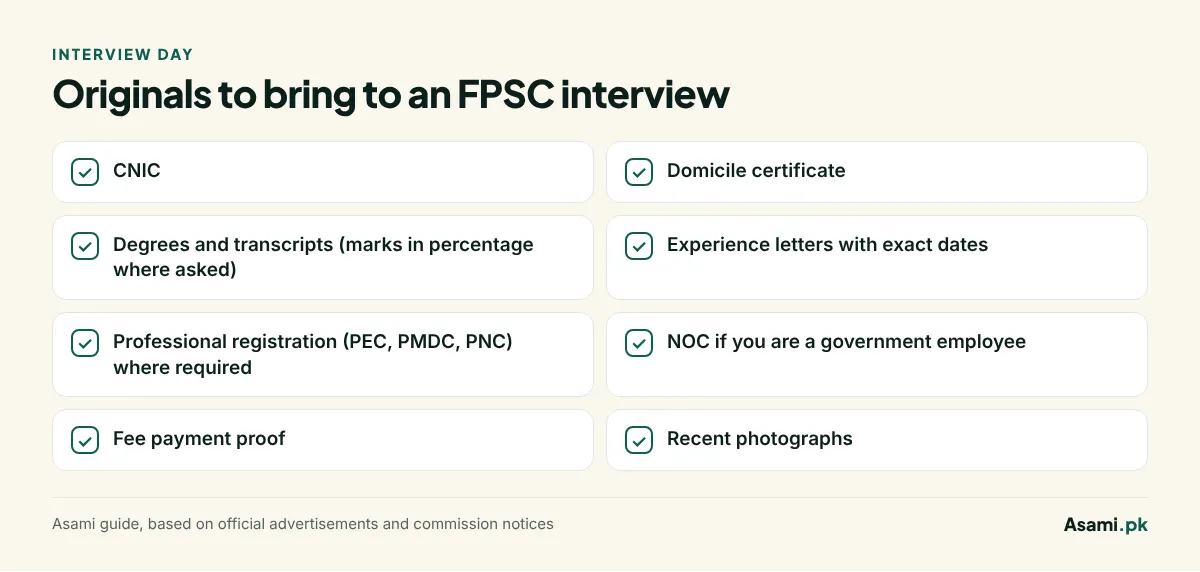
Document verification happens on the same day. Bring the original CNIC, domicile, every degree and transcript, experience certificates, registration certificates and the NOC or departmental permission if you are a government servant, plus a set of attested photocopies. Missing originals are one of the most common reasons strong candidates are not recommended. Dress formally, arrive early, and answer honestly; panels quickly notice rehearsed or inflated claims.
FPSC publishes recommendations by case, listing selected candidates by quota in order of merit. The commission then sends recommendations to the ministry or department, which completes medical examination, character and antecedent verification, and issues the offer of appointment. This last stage is outside FPSC's control and can take weeks or months, depending on the department. If you are recommended, keep your contact details updated and respond quickly to the department's letters. If you are not, check whether the case has a waiting list or whether similar posts are advertised in the next consolidated advertisement; many posts recur every year.
The same avoidable errors cost candidates their chances in almost every advertisement:
FPSC is not the only route into a federal job. Posts below BS-16 are usually filled by the departments themselves, often through testing agencies or the National Job Portal, and many autonomous bodies, regulators and state enterprises recruit on their own. The armed forces, police and banks have separate systems. On Asami, FPSC cases appear on this page, while federal posts recruited directly by departments appear on the relevant department, city or National Job Portal pages, so use the filters on the all-jobs page to see the full picture for your qualification.
It helps to plan around how long FPSC recruitment actually takes. After an advertisement closes, scrutiny and rejection notices usually follow within a few weeks. Screening tests for large cases are often held one to three months after the closing date, and results come a few weeks later. Interviews are then scheduled case by case, sometimes months apart, because the commission handles many cases at once. From the closing date to the final recommendation, six months to a year is common for popular cases, and smaller cases without a test can move faster.
That timeline matters for two reasons. First, keep your documents, email and phone number unchanged for the whole period, because a notice can arrive long after you have forgotten applying. Second, do not put your career on hold while waiting: keep applying to other cases and other recruiters, and treat each FPSC case as one option among several.
Only if your degree is complete by the closing date. FPSC checks qualifications as of the closing date, so a result announced later does not count for that case.
Under the federal quota policy, 7.5% of seats are on open merit, 50% for Punjab including Islamabad, 19% for Sindh (7.6% urban, 11.4% rural), 11.5% for Khyber Pakhtunkhwa, 6% for Balochistan and 2% for AJK, with a small share for Gilgit-Baltistan. 10% of seats are reserved for women and 5% for minorities. Each case row shows the exact split.
No. The PSID payment only pays the fee. You must then complete the online form for that case using the paid PSID.
Age is counted on the closing date of the advertisement, with any relaxation printed in the advertisement's general instructions.
FPSC publishes a list of rejected candidates with reasons and allows a short window for representation. If the rejection is wrong, submit evidence within that window.
It varies by case. A case with a screening test often takes several months from the closing date to final recommendation, and the department's appointment process follows after that.
Find your case in the advertisement on fpsc.gov.pk, pay that case's fee through a 1Link PSID, then complete the online application. Each case needs its own form and fee.
Yes, but seats are allocated by provincial and regional quota, so check that your domicile has a seat in the case you want.
FPSC publishes consolidated advertisements several times a year, each with many cases.
It depends on the grade. For Advertisement 4/2026 it was Rs 600 for BS-16 and BS-17, rising for higher grades.
No. CSS fills the elite occupational groups, while general recruitment through consolidated advertisements fills hundreds of other federal posts.