
4 days left30 Nov 2026
Special Branch Punjab Police
Special Branch Punjab Police Jobs 2026 - 61 Intelligence Operator (BS-07) Posts
📍 LahoreBPS-7intermediate
✓ Verified · Added 18 Nov · Source: Special Branch Punjab Police · 15 Nov 2026
Asami never charges any fee and never collects applications. Apply only on official websites.
1 open job, 61 posts from 1 organisation · updated 26 Nov 2026
Provincial police forces and the Islamabad Police recruit constables, ASIs and specialist units such as the Dolphin Force. Police recruitment advertisements from all provinces are grouped here.
Special Branch Punjab Police
✓ Verified · Added 18 Nov · Source: Special Branch Punjab Police · 15 Nov 2026
Kept for reference only. You can no longer apply to these.

Islamabad Police
✓ Verified · Added 10 Nov · Source: Daily Express · 1 Nov 2026
Pakistan has separate police forces for Punjab, Sindh, Khyber Pakhtunkhwa, Balochistan, Islamabad Capital Territory, Gilgit-Baltistan and AJK, plus federal forces such as the Motorway Police (National Highways and Motorway Police). Each recruits independently. Constables and some lower ranks are usually recruited directly by the force, often through a testing agency (NTS, PTS, OTS, ETEA or NPF Testing & Assessment Services). Sub-Inspectors and ASIs are recruited by the force or the provincial public service commission. Officers enter through provincial commission exams or CSS for the Police Service of Pakistan.
Most police recruitment is domicile-based: provincial forces recruit their own province's residents, often by district. Islamabad Police recruits on a national quota, which is why its advertisements list seats for every province and region.
The main direct-entry ranks are:
Unlike most government jobs, police recruitment has strict physical requirements that often aren't relaxable: minimum height, chest measurement for men, a timed run, and eyesight standards. Islamabad Police's 2026 Dolphin Force advertisement, for example, required men to be at least 5 feet 7 inches with a 33 x 34.5 inch chest and to run 1.6 km in 7 minutes, and women to be 5 feet 2 inches and run it in 10 minutes. Other forces set their own numbers. Measure yourself honestly and train for the run before paying any fee.
Age limits typically start at 18, with upper limits around 25 to 30 for constables (plus any general relaxation) and somewhat higher for ASI and SI posts. Check each advertisement.
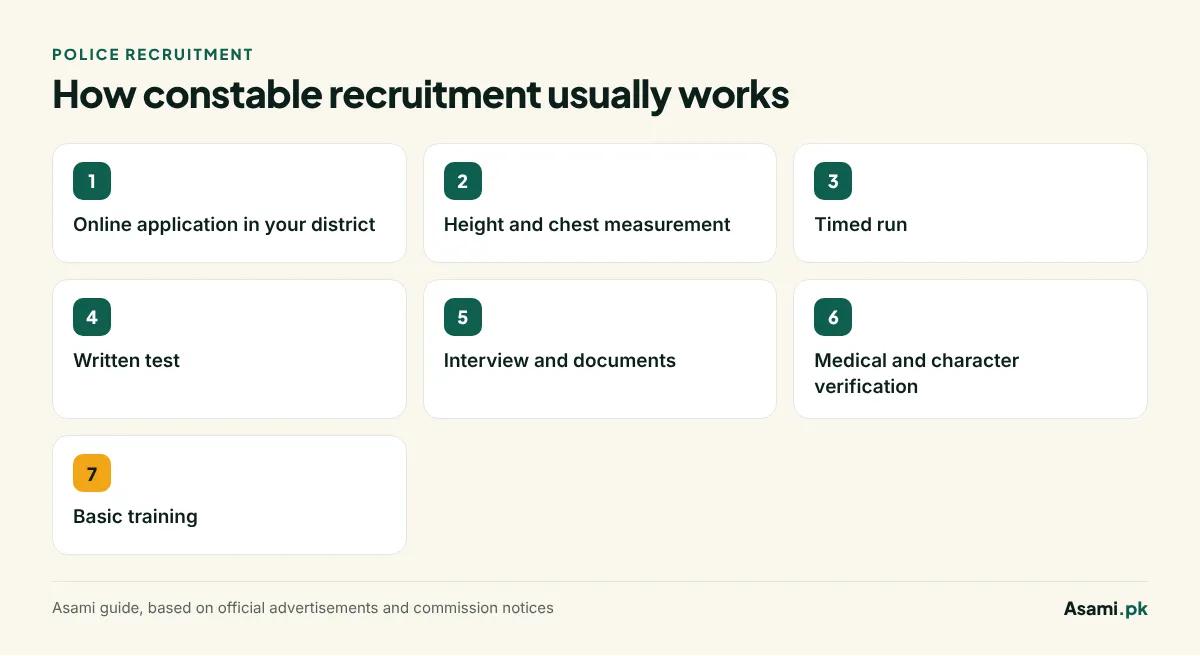
Most forces follow the same sequence: online application and fee through the testing agency, physical measurement and running test, written test, interview, then medical and character verification before training. The physical stage comes first in many forces and eliminates the most candidates. After selection, recruits go through police training school before posting.
Fees vary by force and rank (Islamabad's 2026 recruitment charged Rs 2,000 per post) and are always paid through official channels such as a 1Link PSID, never to individuals.
Police recruitment attracts many fraudsters promising selection for money, fake call letters or 'quota' seats. No genuine police recruitment works this way. Selection is by tests and merit, and fees go only through the advertised official channel. Report anyone asking for money to the force concerned or the FIA.
Police written tests for constables are usually matric-level MCQs covering general knowledge, Pakistan studies, Islamiyat, English, Urdu, basic mathematics and everyday reasoning. For ASI and Sub-Inspector posts, the paper moves up to graduate level and often adds current affairs, basic legal awareness (key sections of the Pakistan Penal Code, the Code of Criminal Procedure and the police's role), and sometimes computer skills.
A practical plan is to revise matric textbooks for Pakistan studies and general science, practise mental arithmetic daily, read one newspaper a day for current affairs, and attempt timed practice papers in the last two weeks. Graduates aiming for ASI or SI should also read a basic introduction to criminal law and procedure, because interview panels often probe it.
Police work is shift-based, often at night and on holidays, and involves dealing with people at their worst moments: victims, suspects, angry crowds and grieving families. Constables do patrolling, guard duty, traffic and escort work, and support investigations. Rapid-response units like Islamabad's Dolphin Force patrol on motorcycles and respond to emergencies. ASIs and SIs record reports, investigate cases, lead teams and appear in court. It's demanding work that suits people who are physically fit, calm under pressure and committed to public service.
Women officers are increasingly recruited across forces, both for general duties and for handling cases involving women and children. Most forces now reserve seats or run dedicated intakes for women.
Passing the tests isn't the end. Selected candidates go through a medical examination that checks eyesight, hearing, general fitness and freedom from disqualifying conditions, and a character and antecedent verification through police records and references. Any undisclosed criminal case can lead to disqualification, so answer every question on the application honestly. If you wear glasses, check the force's eyesight rules: some accept corrected vision and others don't.
Keep your documents consistent too. Your name, father's name and date of birth must match across your CNIC, educational certificates and domicile, or verification can stall.
New recruits attend a police training school or college run by their force, where basic training covers drill, weapons handling, law and procedure, investigation basics, first aid and physical conditioning. Training is residential and disciplined, and completing it successfully is a condition of confirmation in service. Starting your fitness routine well before recruitment makes training far easier.
Punjab Police is the country's largest force and recruits constables, lady constables, drivers and specialised staff through district and regional recruitment drives, while Assistant Sub-Inspector and Sub-Inspector posts are filled through PPSC in many years. Constable drives are usually advertised district by district, with seats for each district and a separate share for women. Applications are typically online through the Punjab Police recruitment portal or a testing agency named in the advertisement, followed by physical measurement, running test, written test and interview.
Because seats are allotted by district, your domicile district matters. Apply in the district that issued your domicile, and check whether the advertisement asks for residence as well. Punjab's Special Protection Unit, Counter Terrorism Department and Dolphin Force recruit separately at times, each with its own standards, so read those advertisements closely.
Sindh Police recruits constables and other ranks through range or district drives, with tests often conducted by an independent testing body named in the advertisement. Seats are distributed by district and, in some drives, by rural and urban areas, and candidates need a Sindh domicile and PRC. Sindh has also run separate drives for traffic police, special security units and female constables. Read which range or district each advertisement covers, because applying in the wrong one leads to rejection.
KP Police recruits constables through district drives, with written tests usually conducted by ETEA. Physical tests and interviews are held at district or regional level. Seats are allotted by district, so apply in your domicile district. KP Police also recruits for special branches such as the Elite Force and Counter Terrorism Department, and for sub-inspectors and assistant sub-inspectors through the KP Public Service Commission or departmental exams, depending on the year.
Balochistan Police and the Balochistan Levies recruit through district drives with physical tests, written tests and interviews, often for large numbers of constables. Islamabad Capital Territory Police recruits through testing agencies such as NPF TAS, with seats distributed by provincial quota because the force serves the federal capital. AJK Police and Gilgit-Baltistan Police recruit their own residents through drives announced by their inspectors general, and their sub-inspector posts are sometimes filled through the AJK and GB public service commissions. Asami lists each of these on this page when an advertisement is verified.
Several federal forces recruit for duties similar to police work: the Federal Investigation Agency, the Motorway Police (National Highways and Motorway Police), the Frontier Constabulary, Pakistan Railways Police and the Airport Security Force. Each has its own physical standards and selection process. FIA and Motorway Police officer posts are often filled through FPSC, while constables and junior ranks are recruited directly. These posts are usually open to candidates from every province under the federal quota.
Most police physical tests include height and chest measurement and a timed run, often 1,600 metres for men and a shorter distance for women, with some forces adding push-ups, sit-ups or a long jump. Height and chest are fixed; if you are below the minimum, no preparation helps, so measure yourself before applying. The run is where preparation pays off. Start eight to ten weeks before the expected test, run three or four times a week, and build up from a steady jog to timed runs at the target pace.
On the day, warm up for ten minutes, wear proper running shoes and avoid a heavy meal beforehand. Candidates who fail the physical test are usually sent home without taking the written test, so this stage decides more applications than any other.
The written test for constables is usually at matric to intermediate level and covers general knowledge, Pakistan studies, Islamic studies, basic English, Urdu and mathematics, with some forces adding questions on traffic rules or basic law. Past papers from the same force or testing agency are the best guide. The interview checks documents, general awareness and attitude: why you want to join, how you would handle a public complaint, and your understanding of discipline and service.
Bring originals of your CNIC, domicile, educational certificates and any driving licence to the interview, along with photocopies and photographs. Candidates who misstate their age or education are excluded at this stage.
There are three main officer routes. The Police Service of Pakistan (ASP) is filled through the CSS exam conducted by FPSC. Provincial DSP posts are filled through the provincial competitive exams of PPSC, SPSC, KPPSC and BPSC in the years they are included. Sub-Inspector and Assistant Sub-Inspector posts are filled through provincial commissions or departmental tests. Each route has its own age limit, education requirement and physical standards, and our FPSC and provincial commission pages explain the processes in detail.
These mistakes end many police applications before the written test:
Police drives check documents at several stages, and missing one can end an application. Prepare originals and photocopies of your CNIC, domicile from the district you are applying in, matric and intermediate certificates with marks sheets, a recent character certificate from a gazetted officer or local authority, and passport-size photographs. Driver posts need a valid licence of the category stated in the advertisement, often LTV or HTV, with the required years of driving experience. Some forces also ask for a medical fitness certificate at a later stage.
Check that the date of birth on your CNIC matches your matric certificate. Discrepancies between these two documents are one of the most common reasons police candidates are rejected at document verification.
Every provincial force now reserves seats for women, and many drives advertise separate lady constable posts with their own physical standards, usually a lower height requirement and a shorter running distance. Women officers work in women's police stations, investigation units, gender protection units, traffic and front-desk services, and their numbers are growing in every province. Read the women's seats and standards in each advertisement; they often differ significantly from the men's.
Constables usually join at BPS-7, with allowances for risk and uniform added to the basic pay, and police service carries pension and medical benefits under provincial rules. New recruits complete basic training at a police training college or school, typically lasting several months, covering drill, weapons handling, law, investigation basics and physical fitness. Promotion from constable to head constable, ASI and SI depends on courses, exams and service record. Officers who join as ASI or SI, or through the DSP or ASP routes, start higher and follow their own training paths.
Before appointment, every police recruit goes through character and antecedent verification, usually carried out by Special Branch and the local police station. Any criminal case, even a minor one, can delay or stop an appointment, so declare everything honestly on your forms. Candidates found to have hidden a case are usually disqualified, and appointments can be cancelled later if a concealed record comes to light.
Most forces now take applications online, either through their own recruitment portal or through a testing agency such as ETEA, NPF TAS, NTS or a university testing service. The steps are similar: register with your CNIC, choose the district and post, fill in your education and personal details, pay the test fee through the channel shown (often a PSID or bank challan), upload your documents and download the application form or token. Some forces then ask candidates to bring the printed form to the physical test.
Read the advertisement for the exact portal and fee, and ignore any website or social media page that is not named in it. Fake recruitment portals copying police logos appear in almost every major drive.
Traffic wardens in Punjab and traffic police in other provinces are often recruited separately, usually requiring intermediate or graduation, a driving licence and good communication skills, along with physical standards. Special units such as counter-terrorism departments, elite forces and special protection units have stricter physical tests and sometimes higher education requirements, with extra training after selection. These advertisements appear less often, so keep an eye on this page if you are interested in specialist roles.
Before applying, think about which rank suits your education and goals. With matric or intermediate, constable is the realistic entry point, and promotion follows with service and courses. With a bachelor's degree, ASI or SI entry through a provincial commission or departmental test offers a higher start, though competition is strong. Graduates aiming for leadership roles should consider the DSP route through provincial competitive exams or the ASP route through CSS. Applying for the post that matches your profile gives you the best chance of success.
Once you clear the physical test, written test and interview, the force publishes a merit list by district and quota. Selected candidates then go through medical examination and character verification before receiving an appointment order and joining instructions for training. Keep your phone active and respond quickly to every call, as late reporting can cost you the place. If you are on a waiting list, the force may call you if selected candidates fail to join or are found ineligible, so keep your documents ready even after the main list is out.
Police recruitment drives are announced through newspaper advertisements, the force's official website and, increasingly, official social media accounts. Drives come at irregular intervals, often after budget approvals for new posts, so it is easy to miss one. Asami lists every verified police advertisement on this page with its district seats, standards and last date, and links to the official source. Following our WhatsApp channel is another way to hear about new drives as soon as they are verified.
Before you apply, run through a short checklist. Is your domicile from the district or province the advertisement covers? Do you meet the height, chest and age standards on the reference date? Does your education match the post? Can you run the required distance in the time set? Is the portal or address in the advertisement an official one? If the answer to each question is yes, apply early and start preparing for the physical test the same week. If any answer is no, wait for a drive that fits you rather than paying a fee you are likely to lose.
Provincial police forces generally require a domicile from that province, and often from the district. Federal forces recruit from every province under quota.
Usually a small test fee is paid through the channel in the advertisement. Never pay anyone else.
KP Police constable written tests are usually conducted by ETEA, as named in each advertisement.
Provincial DSP posts are filled through provincial competitive exams in the years they are included. The ASP route is through CSS.
No. Distances and times vary by force and gender; the advertisement or call letter gives the exact standard.
Apply through the force's advertised testing agency or website, paying the official fee, then pass the physical test, written test, interview and verification.
It varies by force. Islamabad Police (2026) required 5 feet 7 inches for men and 5 feet 2 inches for women, with no relaxation.
Usually matric, along with physical standards and age limits set by the force.
Provincial forces generally recruit their own domicile holders. Islamabad Police recruits on a national quota.
Yes. Most forces include a timed run, for example 1.6 km in 7 minutes for men in Islamabad Police's 2026 recruitment.