
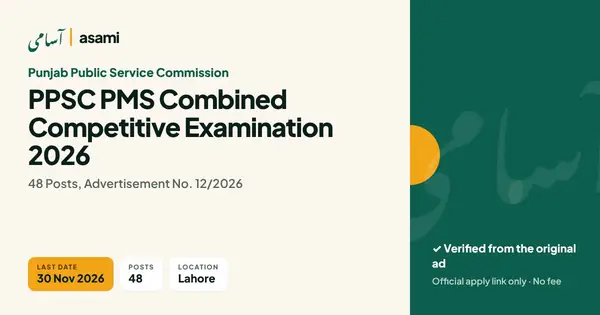
4 days left30 Nov 2026
Punjab Public Service Commission
PPSC PMS Combined Competitive Examination 2026 - 48 Posts, Advertisement No. 12/2026
📍 LahoreBPS-17bachelor
✓ Verified · Added 10 Nov · Source: Dawn · 8 Nov 2026
Asami never charges any fee and never collects applications. Apply only on official websites.
2 open jobs, 273 posts from 1 organisation · updated 26 Nov 2026
Every open PPSC jobs advertisement, explained in plain language with the posts table, eligibility, last date and the official ppsc.gop.pk online apply route. Upcoming PPSC jobs are added as soon as the commission publishes them. The Punjab Public Service Commission is the largest provincial recruiter in the country, covering Punjab government departments, the PMS examination and lecturer recruitment. PPSC advertisements, test schedules and results guidance live in this section.
Punjab Public Service Commission
✓ Verified · Added 10 Nov · Source: Dawn · 8 Nov 2026

Punjab Public Service Commission
✓ Verified · Added 23 Nov · Source: Punjab Public Service Commission · 22 Nov 2026
The Punjab Public Service Commission is the busiest recruitment body in Pakistan, covering Punjab government departments, the Provincial Management Service, lecturers, police and hundreds of other posts every year. This hub collects every PPSC advertisement we process and explains, in plain steps, how its test schedules, roll number slips, results and past papers work.
PPSC applies online only. The application fee is deposited through the channels named in the advertisement, which include mobile banking and bank branches, and the fee details are entered in the online form. No hard copy is needed unless the advertisement or a later notice asks for one.
Read the qualification and age rows for your exact post. PPSC age limits are calculated on the closing date and the general relaxation already included in the advertisement should not be added twice.
Independent guide, not affiliated with the Punjab Public Service Commission. Official notices on www.ppsc.gop.pk always take priority.
The Punjab Public Service Commission recruits for Punjab government posts from BS-16 upward, plus the Provincial Management Service through its Combined Competitive Examination. Because Punjab is Pakistan's largest province, PPSC is the biggest public service commission in the country by volume. In a typical year it advertises lecturers for government colleges, medical and dental officers, engineers, tehsildars and naib tehsildars, sub-inspectors, assistant directors across departments, and hundreds of other posts.
Its advertisements are numbered (for example Advertisement No. 12/2026) and each contains numbered cases. Lecturer recruitment is often advertised subject by subject, so a single advertisement can list dozens of lecturer cases.
PPSC posts are generally reserved for candidates with a Punjab domicile. Some posts reserve seats for women, minorities and special persons, and these quotas are listed against each case. Age limits differ by post. Many general posts are 21 to 30 or similar with Punjab's age relaxation rules applied, while the PMS exam has its own limits. For example, the 2026 exam allowed up to 32 under a special notification.
Qualification requirements are strict about divisions, marks and subjects. Lecturer posts, for instance, specify the master's or BS subject and minimum marks. PPSC asks for percentage marks in many cases, so keep a percentage conversion of any CGPA ready.
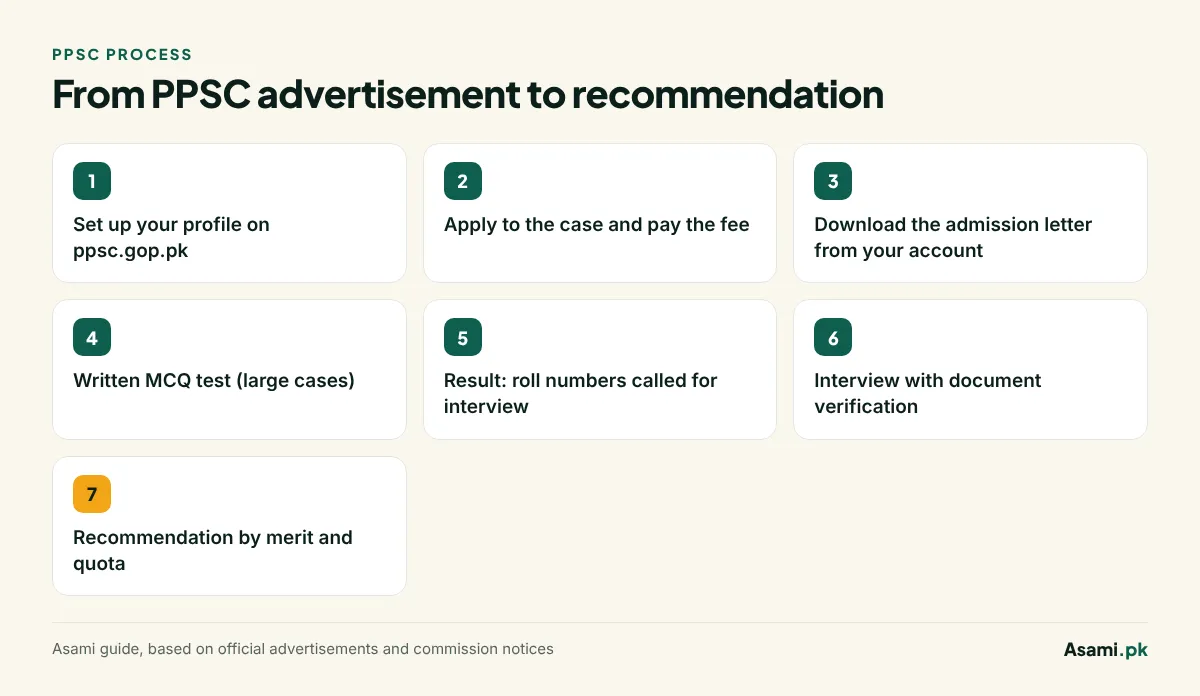
All PPSC applications go through the commission's online system at ppsc.gop.pk. Create an account linked to your CNIC, complete your profile carefully (education, experience, domicile), then apply to individual cases. Fees are paid through the payment channels shown in the application (ATM, mobile and internet banking, 1Link, and mobile wallets). Every case is a separate application.
After applying, everything flows through that account: admission letters, test alerts, interview calls and result notices. Keep your phone number and email current, and log in occasionally to check for updates.
Most PPSC cases follow these steps:
A few PPSC post families attract most applicants. Lecturers (BS-17) need the relevant master's or BS (Hons) subject, with marks and division conditions; tests are subject-heavy. Tehsildar and Naib Tehsildar posts lean on general ability and revenue knowledge. Medical and dental officers need PMDC registration, and selection weighs academic record and interview. Sub-Inspector and other police-related posts include physical standards set by the department. Assistant Director posts across departments usually need a relevant 16-year degree.
Knowing which family your target post belongs to tells you how to split your preparation between the subject and general ability, and what to expect at interview.
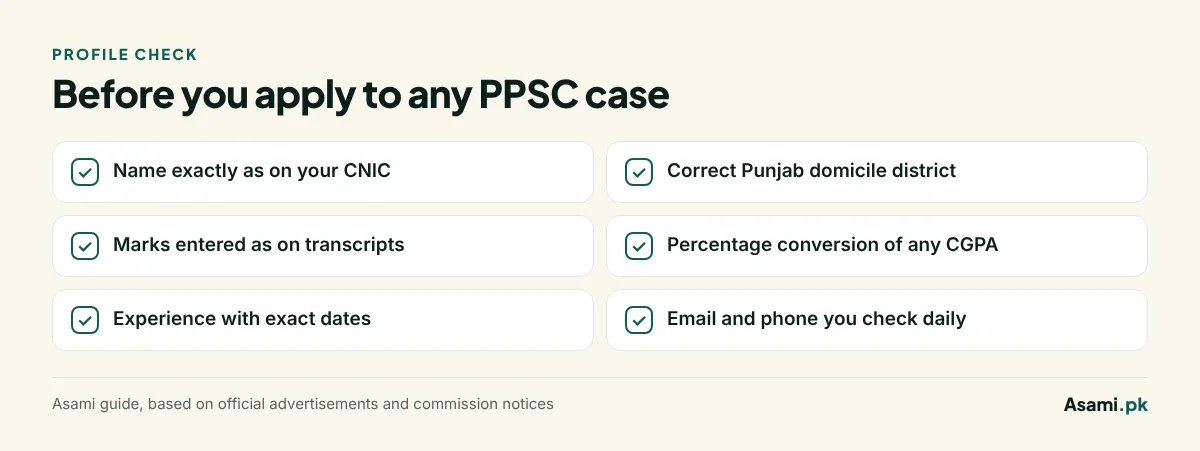
Because every PPSC application draws on the same online profile, an error there repeats across all your applications. Before applying, check that your name matches your CNIC exactly, your degree marks are entered as on your transcripts, and your domicile district is correct. Update experience entries with exact dates. Fixing the profile once saves you from rejections in several cases later.
Use the guide links near the top of this page for PPSC's test schedule, admission letter (roll number slip), results and past papers. When PPSC announces a stage for an advertisement on our board, we post a notice there and on the job's timeline, linking straight to the official document.
PPSC advertisements are published in major newspapers and on ppsc.gop.pk, each with a number and year and a list of cases. Every case has a case number, the department, the post title and BS grade, the number of seats with their quota split, the qualification, the age limit and a few special conditions. The general instructions at the end of the advertisement apply to every case and cover fee rules, age relaxation, the treatment of government servants, and how PPSC calculates marks. Read both the case row and the general instructions before applying.
A useful habit is to copy your case row into a note with the case number, closing date and every condition. When PPSC later publishes a test schedule or result, it refers to the case number, so having it at hand saves time and confusion. If a corrigendum is issued, it appears on the website under the same advertisement number; check for one before you submit.
For most PPSC posts, a Punjab domicile is required, and seats inside a case are split between open merit and reserved shares for women, minorities and persons with disabilities. Some posts, especially those tied to a district or division, also restrict seats by region, so read the case row closely. If your domicile is from another province, you can generally apply only where the advertisement says the post is open to all Pakistanis.
Punjab's rules allow age relaxation for several groups. Government servants usually get relaxation equal to their service up to a ceiling, and there are relaxations for persons with disabilities and, in some periods, a general relaxation announced by the Punjab government. Each advertisement states which relaxations apply and the reference date for age. Do the calculation on that exact date. Applying when you are a few days over the limit, hoping for leniency, simply wastes the fee.
Everything with PPSC happens in your online account, so set it up carefully once. Register on ppsc.gop.pk with your CNIC, a mobile number registered in your name and an email address you check daily. Then complete the profile: personal details exactly as on your CNIC, father's name, domicile district, and every qualification from matric onward with board or university, year, total and obtained marks. Add experience with exact dates and employer details, and upload a recent passport-size photograph against a plain background.
Once the profile is complete, each application simply picks up these details, which is why an error in the profile spreads to every application. If you later earn a new degree or change jobs, update the profile before applying to the next case. Keep your login details safe; PPSC will never ask for your password by phone or message.
When you apply to a case, the system shows the fee for that grade and a payment reference. Pay it through one of the listed channels, such as an ATM, internet or mobile banking, 1Link or a mobile wallet, and confirm that the payment is reflected against your application. Every case is a separate application with its own fee, so applying to three lecturer subjects means three payments.
Submit the application before the closing date shown in the advertisement and download or print the final copy. PPSC also allows candidates to view their application status in the account. If a payment is deducted but not reflected after a reasonable time, contact PPSC's help desk with the transaction ID; do not make a second payment until you know the first has failed.
For cases with many applicants, PPSC holds a written MCQ test. A typical general-ability paper covers general knowledge, Pakistan studies, current affairs, Islamic studies, English, Urdu, basic mathematics and everyday science, with the share of each depending on the post. Subject posts such as lecturers add a large professional section on the relevant subject. PPSC publishes the syllabus or test pattern in its notices, and its past papers give a good sense of the level and style of questions.
Admission letters are issued online through your account, not by post, shortly before the test. The letter gives your roll number, test centre, date and reporting time, and it must be printed and brought with your original CNIC. Mobile phones, smart watches and calculators are not allowed in the hall unless the notice says otherwise. Our PPSC test schedule, roll number slip and past paper guides cover these steps in more detail.
After the written test, PPSC publishes the result as a list of roll numbers that qualified for interview, generally in a ratio to the number of seats. Qualifying candidates are asked to submit or bring certain documents, and the interview schedule is published on the website. At the interview, PPSC verifies original documents and a panel assesses your subject knowledge, general awareness and suitability. For many posts, the final merit combines written test and interview marks, with academic record also counting in some cases.
Prepare for the interview by revising your subject, the work of the department you are joining, and current affairs in Punjab and Pakistan. Bring originals of your CNIC, domicile, degrees, transcripts, experience certificates and any NOC, along with attested copies. PPSC's interview notices list the documents required for each case; follow that list exactly.
The Provincial Management Service exam is PPSC's equivalent of CSS for Punjab. It fills posts such as PMS officers, Excise and Taxation Officers and Local Fund Audit posts, depending on the year. Candidates need a bachelor's degree and a Punjab domicile and must be within the age limit set for that year's exam. The exam includes compulsory papers such as English essay and précis, general knowledge, Pakistan affairs, Islamic studies and current affairs, plus optional papers chosen by the candidate, followed by a psychological assessment and interview.
Unlike regular cases, the PMS form asks you to rank your preferred posts. Allocation after the final result follows merit and those preferences, so think carefully about which posts you would actually accept and in what order. The PMS page on Asami covers the 2026 exam in detail.
Lecturer posts in Punjab's government colleges are among PPSC's largest recruitments. They are advertised subject by subject and often separately for male and female colleges. Eligibility usually requires a master's or BS (Hons) in the relevant subject with a minimum division or percentage, and selection weighs the written test, academic record and interview. Because tests are heavily subject-based, preparation should centre on the full master's syllabus of your subject, past papers and teaching methodology. Apply only in the subject that exactly matches your degree title, as close-but-different subjects are frequently rejected at scrutiny.
These are the errors that most often cost PPSC candidates their chance:
PPSC handles posts from BS-16 upward and certain specified posts. Many lower-grade Punjab jobs, such as clerks, teachers under school education programmes, and district-level staff, are recruited directly by departments, often through the Punjab Job Portal or testing agencies. Asami lists these on the Punjab, city and department pages, so if you are looking for posts below BS-16, use those pages alongside this one.
Most PPSC candidates have between four and eight weeks between applying and the written test. A simple plan works better than collecting books. In the first week, read the case's syllabus or test pattern and solve one past paper under timed conditions to see where you stand. Use that result to divide your time: subject posts need most of the time on the professional section, while general posts need a balanced spread across general knowledge, Pakistan studies, English and mathematics.
In the following weeks, study one area each day, and end the week with a full timed paper. Keep a notebook of facts you got wrong; for general knowledge and current affairs, that notebook will be your best revision material in the final days. For current affairs, follow national news for Punjab and Pakistan, including budget headlines, new laws, major appointments and international events involving Pakistan. In the last week, revise the notebook, solve two or three more past papers, and confirm your test centre and travel plan.
Many PPSC tests apply negative marking or very tight time limits, depending on the notice, so practise answering quickly and skipping questions you are unsure about. The aim is to be among the top scorers for your case's seats, not to answer every question.
PPSC publishes written test results, interview schedules and final recommendations on its website, usually as PDF documents listed by advertisement and case number. Results are also reflected in your online account. Because these lists use roll numbers, keep your admission letter after the test so you can find yourself on the result list. If you qualify, the result notice explains the next step and the documents required.
Final recommendations are published as merit lists by quota. If you are recommended, the department, not PPSC, sends your appointment offer after its own checks, including medical fitness and verification of character and documents. If you are not recommended but scored well, watch for future advertisements in the same post family; many Punjab posts are advertised every year or two.
Serving government employees can apply to PPSC posts, but they must inform their department and follow the rules on permission. Many advertisements require an NOC or a departmental permission letter at the interview, and some ask for applications through proper channel. Start the NOC process as soon as you apply, because offices can take weeks to issue it. Government servants also usually receive age relaxation equal to their length of service, up to a limit set in the rules, so check whether this helps you qualify for a case you thought was out of reach. Keep a copy of your service certificate showing your date of joining, since PPSC may ask for it to verify the relaxation.
Usually not for core details. Check your profile carefully before submitting, and contact PPSC promptly if a genuine error needs correcting.
PPSC issues admission letters online through your account on ppsc.gop.pk, shortly before the test. They are not sent by post.
Usually general knowledge, Pakistan studies, current affairs, Islamic studies, English, Urdu, basic mathematics and everyday science, with a subject section for professional posts. Each case's notice gives the exact pattern.
Yes, but each case is a separate application with its own fee.
Yes, for groups such as government servants and persons with disabilities, and sometimes a general relaxation. The advertisement lists what applies.
Regular PPSC cases recruit for specific posts. The PMS exam is a competitive exam for provincial management and related services, with written papers, a psychological test and an interview.
Create an account on ppsc.gop.pk, complete your profile, and apply online to each case separately, paying the fee shown during the application.
PPSC posts generally require a Punjab domicile. Check each case's eligibility.
PPSC advertises throughout the year. New advertisements appear on ppsc.gop.pk and are listed on this page as soon as they're verified.
No. Cases with many applicants have written tests; smaller cases may go directly to interview.
PPSC often asks for marks in percentage, especially at interview, so keep a percentage conversion of your CGPA ready.