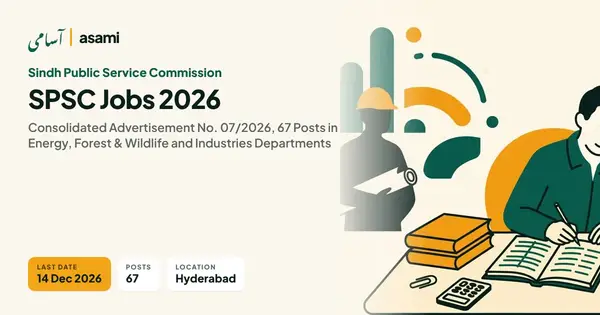
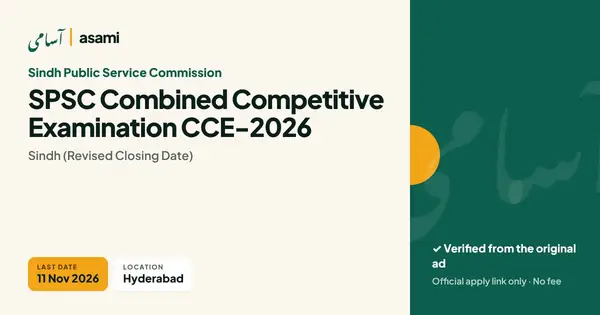
The Sindh Public Service Commission recruits for Sindh government departments and runs the Combined Competitive Examination for the province. SPSC advertisements and notices are collected here.
✓ Verified · Added 10 Nov · Source: Sindh Public Service Commission · 23 Oct 2026
About SPSC recruitment
The Sindh Public Service Commission recruits for Sindh government departments and holds the Combined Competitive Examination for the province. Its schedules, admit cards and results are posted on spsc.gov.pk.
Independent guide, not affiliated with the Sindh Public Service Commission. Official notices on www.spsc.gov.pk always take priority.
No new notices in these categories yet; they are added as SPSC publishes them.
SPSC Result
SPSC posts screening test results, interview programmes and final results on spsc.gov.pk, each as a separate notice for the posts concerned.
Results usually come in stages: candidates qualifying the screening test, then those called for interview, then the final result naming the candidates recommended for appointment. Each list is published post by post.
We never announce SPSC results before the commission does. For posts listed on Asami, we add each official result notice here with a link to the source document.
Open spsc.gov.pk and go to the results section.
Find the advertisement number and post.
Search the result list for your roll number.
SPSC Admit Card
SPSC issues admit cards, commonly called roll number slips, through its online system before each test. You download and print the card yourself.
The admit card shows your roll number, name, photograph, the post and its advertisement number, the test date and reporting time, and the venue. Without it and your original CNIC, the venue staff won't let you sit the paper.
Admit cards are generally released a few days before a test. If yours isn't available when others for the same post are, check your application status in your account and then contact the commission using the details on its website.
Log in to the SPSC online system with the account you applied from.
Open your application and download the admit card once released.
Print it and carry it with your original CNIC on test day.
SPSC Test Schedule
SPSC publishes test and interview programmes as notices on spsc.gov.pk, listing each post with its advertisement number and test date.
The commission handles recruitment for dozens of Sindh departments at once, from lecturers and medical officers to assistants and engineers. Rather than one annual calendar, it issues programmes that cover a batch of posts: a screening test schedule for posts with many candidates, and interview programmes for posts at the final stage.
The Combined Competitive Examination for PCS and related services has its own announcements, separate from the general recruitment programmes. When SPSC posts a schedule for a job listed on Asami, we add the notice here with a link to the commission's document.
Postponements and revised programmes
Programmes are sometimes postponed, for instance because of public holidays, weather, law and order, or court cases concerning a recruitment. SPSC issues a fresh notice when this happens. Your application remains valid, and a new admit card or a note on the old one tells you the new date. Avoid relying on social media posts about postponements; many are wrong, and missing a test because of a false rumour can't be undone.
On Asami, we only add an SPSC programme to this page once it's on the commission's website, and we update the related job page at the same time.
Open spsc.gov.pk and look under the latest notices or test programme section.
Find your advertisement number and the post you applied for.
Note the date, time and venue city, and check again before you travel.
SPSC Past Papers
SPSC screening tests follow the syllabus the commission publishes. Past papers show the style of questions but the official syllabus decides what to study.
Many SPSC posts begin with a multiple-choice screening test that mixes general knowledge, English, Pakistan studies, Islamiat or ethics, current affairs, everyday science and basic mathematics with a portion related to the post. Professional posts may also have a subject test. Your post's syllabus on the commission's website is the authority.
Collections of past questions are compiled by private publishers and academies, not by the commission. Use them for practice, check doubtful answers, and ignore anyone offering the real paper in advance.
Download the syllabus for your post from spsc.gov.pk.
Study the subject portion from standard textbooks.
Practise timed MCQ sets for the general portion.
Sindh domicile, PRC and the rural-urban split
SPSC eligibility rests on two documents: a Sindh domicile and a Permanent Residence Certificate (PRC, often called Form-D). Seats are divided between Sindh's rural and urban quotas (and sometimes women, minority and disability quotas), and each post's seat table shows the split. When you apply, you declare your quota based on your domicile, and SPSC's advertisements warn that domicile, PRC and quota details can't be changed after the closing date. An error here can cost you the seat even if you top the test.
Age limits vary by post, with general relaxation applied as Sindh's notifications allow. Some field posts, such as forest and wildlife positions, add physical standards for height and walking tests.
Applying to SPSC
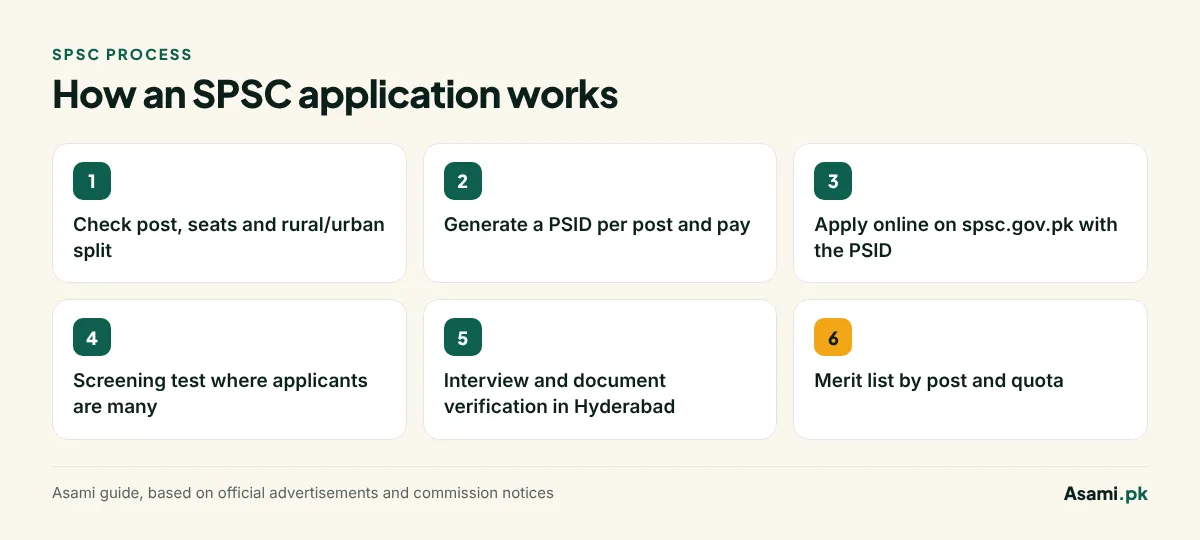
Applications are online at spsc.gov.pk. For each post, generate a PSID for the fee (for example Rs 500 per post in Advertisement 07/2026) and pay it through an online channel using the 1Bill option. Then complete a separate online application. SPSC portals often close at 5:00 pm on the closing date rather than midnight, so don't plan to finish late in the evening.
SPSC typically screens large applicant pools with an MCQ test, using a stated pass mark and sometimes negative marking. The CCE screening in 2026 required 33% with 0.25 marks deducted per wrong answer. Written papers or interviews follow.
SPSC now collects fees through a PSID linked to the post. You generate the PSID through the commission's system and pay it through a banking app, internet banking or an ATM using the 1Bill option, then enter the PSID in the application. In Advertisement 07/2026 the fee was Rs 500 per post, but check each advertisement because fees can change. One payment covers one post only. If you apply for three posts, you need three PSIDs and three payments, and each form must carry its own paid PSID.
Keep a screenshot of each payment confirmation. If the portal does not recognise a paid PSID, contact SPSC's help desk with the transaction details before paying again. The fee is not refundable, so finish your eligibility checks before paying.
The SPSC application and selection steps.
Documents to keep ready for SPSC
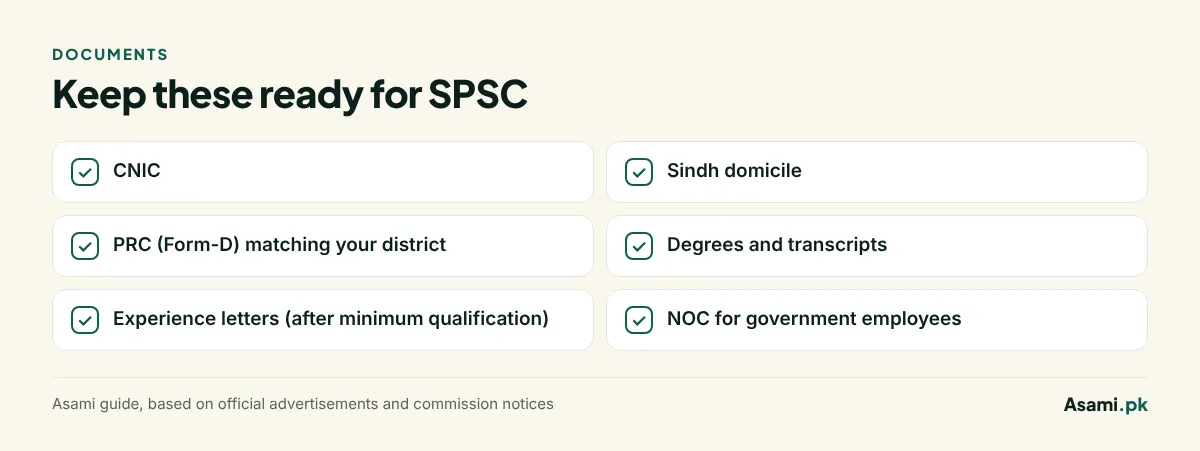
SPSC applications move quickly once an advertisement opens, and candidates who scramble for documents often miss the portal's 5:00 pm close. Keep clear scans of your CNIC, Sindh domicile, PRC (Form-D), matric to final-degree certificates and transcripts, any professional registration (PEC, PMDC, PVMC, Sindh Bar Council), experience letters with exact dates, and a recent photograph. For posts with physical standards, check your height and practise the walking test in advance. Government servants should arrange departmental permission early, because proper-channel forwarding takes time.
Documents SPSC checks.
SPSC tests and preparation
For posts that attract many applicants, SPSC holds a screening test, usually MCQ-based, to bring the number down before interviews or a written exam. The test generally covers general knowledge, current affairs, Pakistan studies, Islamic studies or ethics, English, basic mathematics and, for technical posts, a professional section. SPSC sets a qualifying score and calls candidates who clear it for the next stage. Admit cards are published on spsc.gov.pk, so check the website regularly once the closing date passes.
Prepare from the subject outline SPSC provides and from past papers, and give extra time to Sindh-specific general knowledge: the province's geography, history, major rivers and barrages, districts and divisions, and recent provincial developments. Many candidates lose easy marks there because they prepare only from national books.
For screening MCQs, prepare general knowledge, Pakistan and Sindh affairs, current affairs, everyday science, English, basic mathematics and Islamiyat, with timed practice. Where negative marking applies, practise answering only when you can eliminate options. For specialist posts, the professional section and interview test your subject in depth: mining safety law for coal mine inspectors, wildlife ecology for rangers, or boiler regulations for boiler inspectors. Prepare from the field's standard references rather than general MCQ books.
SPSC CCE: Sindh's provincial civil service exam
The Combined Competitive Examination is SPSC's flagship recruitment. Graduates with at least second division and a Sindh domicile compete for Sindh's provincial service posts in a multi-stage process. An MCQ screening test filters the large applicant pool, then written papers test English, general knowledge and other subjects in descriptive form, and an interview completes the merit. Allocation to specific services depends on your merit position and the preferences you give.
Recent rounds show that SPSC adjusts CCE rules by notification. For CCE-2026, a corrigendum raised the upper age limit to 33, allowed five attempts and extended the closing date. Before applying, read the latest corrigenda alongside the original advertisement, because the newest notice takes precedence.
Interview, document verification and the result
SPSC interviews take place in Hyderabad, the commission's headquarters, and in some cases at other centres. On the day, the commission verifies original documents before the interview, so bring your CNIC, domicile, PRC, every degree and transcript, experience letters, professional registration, and the NOC if you are in government service, along with attested copies. A candidate whose originals do not match the online form can be excluded even after passing the test.
The panel asks about your subject, the work of the department you applied to, Sindh's public issues and your own record. Candidates for engineering and forestry posts, for example, should expect questions about provincial projects, water management or forest conservation in Sindh. Speak plainly and avoid memorised answers.
SPSC publishes final results as merit lists by post and quota. The commission then recommends selected candidates to the Sindh government department, which completes medical checks, police verification and the appointment order. This stage can take several months. If you are recommended, keep your contact details current and respond promptly to the department. If you are not, note that many Sindh posts, such as lecturers, medical officers and engineers, are advertised again within a year or two, so keep your documents updated and watch for the next advertisement.
Common SPSC mistakes
Most SPSC rejections come down to a handful of avoidable errors:
Selecting the wrong rural or urban quota, which cannot be corrected after the closing date.
Paying one PSID and using it for several posts.
Counting experience gained before the minimum qualification.
Leaving the form until the final afternoon when the portal closes at office time.
Bringing a domicile or PRC with a different name spelling from the CNIC.
Ignoring screening test notices because they arrive months after applying.
Frequently asked questions
Does SPSC accept paper applications?
No. SPSC applications are online only, on spsc.gov.pk.
What is the difference between Sindh rural and urban quota?
Your PRC district decides whether you compete for rural or urban Sindh seats. Urban Sindh broadly covers the main urban centres such as Karachi, Hyderabad and Sukkur; the rest of the province is rural.
Where are SPSC interviews held?
Mostly at the commission's headquarters in Hyderabad, though some cases are interviewed at other centres as announced.
Can I correct my quota after the SPSC closing date?
No. SPSC treats domicile, PRC and rural or urban quota as final once the application closes.
How do I apply for SPSC jobs?
Generate and pay a PSID fee for each post through 1Bill, then submit a separate online application on spsc.gov.pk before the 5:00 pm closing time.
Who can apply for SPSC jobs?
Candidates with a Sindh domicile and PRC (Form-D) who meet each post's qualification and age requirements.
Can I change my SPSC quota after applying?
No. SPSC states that domicile, PRC and rural or urban quota details can't be changed after the closing date.
Does the SPSC test have negative marking?
Some SPSC tests do. The CCE-2026 screening deducted 0.25 marks per wrong answer.
What is SPSC CCE?
The Combined Competitive Examination for Sindh's provincial services, such as Assistant Commissioner, Section Officer and DSP.
How do I check my SPSC result?
Open the results section on spsc.gov.pk, find the advertisement and post, and search the list for your roll number.